
Introduction: The Wilderness as a Tactical Theater
Historians analyzing the Wilderness theater prioritize topographical mapping over traditional troop movement charts. The dense foliage dictated engagement distances and rendered standard line-of-sight tactics useless. Visibility dropped to 30 to 40 yards in the densest thickets.
This secondary growth resulted from clear-cutting for the Catharine Furnace operations between 1836 and 1845. Analyzing how a severe tactical disadvantage was reversed through extreme risk and maneuver requires understanding this unforgiving landscape.
The Challenge: Hooker's Initiative and the Outflanked Army
Maj. Gen. Joseph Hooker's operational planning relied on a rapid flanking maneuver to force the Army of Northern Virginia out of its Fredericksburg entrenchments. This shifted the strategic burden to the Confederates while securing his own supply lines. The numbers were stark. Union forces numbered approximately 133,000 against Confederate effectives of roughly 60,000.
Hooker left a critical vulnerability. Maj. Gen. Oliver O. Howard's 11th Corps deployed along a 1.5-mile stretch of the Orange Turnpike facing south. Their right flank hung in the air without natural defensive barriers. This precarious position was compounded by the failure of the 11th Corps to establish adequate forward pickets facing west.
The Solution: The Cracker Barrel Conference
On May 1, 1863, Gen. Robert E. Lee and Lt. Gen. Thomas J. 'Stonewall' Jackson met to evaluate their options. They initially evaluated a shorter flanking route closer to the Union lines. Local guides indicated it would be visible from the elevated Union positions at Hazel Grove, forcing them to drop the idea.
The radical decision emerged to divide an already outnumbered army in the face of a superior enemy force. They planned a 12-mile circuitous march utilizing the Brock Road and an unfinished railroad bed. Departures staggered between 4:30 AM and 7:15 AM on May 2.
Execution: Navigating the 12-Mile Circuit
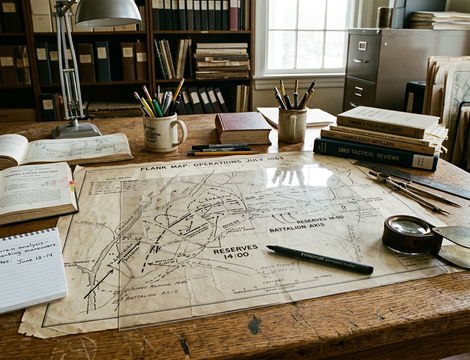
Moving the Second Corps through dense secondary growth required intense logistical discipline.
Expert Tip: Jackson's staff maintained march discipline by instituting a strict silence protocol. They forbade cheering and ordered officers to strike stragglers with the flat of their swords to prevent gaps in the column.
Tactical deception played a role, with Lee demonstrating in force to pin Hooker's attention to the front. The 23rd Georgia deployed approximately 300 men to delay Union probes at Catharine Furnace. J.E.B. Stuart's cavalry maintained a screening distance of 400 to 600 yards on the right flank, blinding Union reconnaissance.
Jackson's Flank March: Order of March (May 2, 1863)| Unit | Commander | Departure Window | Tactical Role |
|---|---|---|---|
| Second Corps Cavalry | Maj. Gen. J.E.B. Stuart | 4:30 AM - 5:00 AM | Flank Screen / Reconnaissance |
| D.H. Hill's Division | Brig. Gen. R.E. Rodes | 5:00 AM - 5:30 AM | Lead Infantry Element |
The Assault: Shattering the Union 11th Corps
Confederate brigade commanders deployed their lines in the dense woods by aligning on the Orange Turnpike. They used the road as the sole reliable axis of advance to maintain unit cohesion. The assault commenced at 5:15 PM, leaving less than two hours of usable daylight.
A two-mile-wide attack front overlapping the turnpike shattered Howard's unprepared troops. The complete tactical surprise collapsed the Union right flank. Acoustic shadow phenomena masked the artillery fire from Hooker's headquarters, delaying the Union response. Hooker subsequently suffered a concussion from artillery fire, leading to the temporary devolution of Union command to Maj. Gen. Darius N. Couch.
The Strategic Cost: Friendly Fire in the Darkness
Jackson advanced beyond his skirmish line to locate a viable route to the United States Ford. He intended to sever the Union army's primary line of retreat before Hooker could reorganize. Jackson's party rode 60 to 80 yards ahead of the Confederate battle line.
Caution: Night reconnaissance in heavily wooded terrain without established passwords severely degraded command and control, making fratricide highly probable.
A fatal misidentification by Brig. Gen. James Lane's North Carolina brigade resulted in Jackson being struck by three.69 caliber smoothbore musket balls at approximately 9:00 PM. Immediate battlefield chaos ensued, devolving Confederate command to Maj. Gen. A.P. Hill, then J.E.B. Stuart.
Medical Intervention and the Loss of a Commander
The field medical response was swift but grim. Dr. Hunter McGuire determined that extracting the ball from the shattered left humerus was impossible due to severe arterial damage. This necessitated an immediate circular operation to amputate Jackson's left arm to prevent fatal hemorrhage. The surgery was performed at 2:00 AM on May 3 under chloroform anesthesia.
Jackson endured a 27-mile ambulance evacuation to the Chandler plantation at Guinea Station. His wife, Mary Anna, and daughter arrived shortly after. The onset of pleurisy and pneumonia culminated in Jackson's death on May 10, 1863.
Results: Tactical Victory, Strategic Deficit
Lee captured the Chancellor House on May 3. The Union retreat across the Rappahannock completed by the morning of May 6. The battle stands as a masterpiece of maneuver warfare achieved at an irreplaceable command cost.
Main Point: Following the campaign, Lee restructured the Army of Northern Virginia. He determined that two massive corps were too cumbersome for a single commander to manage in Jackson's absence. This led to the reorganization of the Confederate army into three corps of three divisions each heading into the 1864 Overland Campaign.
According to measurements from the 2008 National Park Service topographical data, the precise distances of the march and assault highlight the physical toll on the infantry. A National Park Service marker details the exact location of the wounding. While topographical analysis provides a definitive framework for troop movements, the exact psychological impact of the acoustic shadow on Hooker's delayed response remains a subject of interpretive debate among battlefield guides.