

Twilight Decapitation on the Williamsburg Road
The tactical situation at Seven Pines required the army commander's physical presence at the point of maximum friction. According to available data, between 7:00 PM and 7:30 PM on May 31, 1862, Joseph E. Johnston advanced his staff past the intersection of the Nine Mile and Williamsburg roads. Couriers had repeatedly failed to return with actionable intelligence regarding the stalled brigades under W.H.C. Whiting. Johnston abandoned his rearward command post to personally locate the vanguard and force a breakthrough before darkness halted the engagement.
The fading light obscured the exact Confederate lines, drawing the commanding general directly into the zone of active skirmishing. A musket ball—.58 caliber, as commonly cited—struck Johnston in the right shoulder, nearly unhorsing him. Seconds later, a jagged artillery shell fragment impacted his chest, inflicting massive blunt force trauma and breaking multiple ribs. The commanding general fell from his horse into the mud of the Williamsburg Road. This sudden physical trauma instantly decapitated the command structure of the Confederate forces during an active, unresolved engagement. Staff officers scrambled to secure a stretcher, prioritizing the evacuation of their wounded commander over the transmission of tactical updates to the wing commanders.
The immediate removal of the army's central authority paralyzed the local tactical situation. Subordinate generals, unaware of Johnston's fate, continued to execute outdated directives or halted their advances entirely to await fresh instructions that would never arrive. The Army of Northern Virginia lost its operational brain precisely as the twilight counterattacks reached their critical culmination point.
Acoustic Shadows and the Collapse of the Converging Attack
The necessity of Johnston's dangerous forward position stemmed directly from a cascading failure of staff work and environmental anomalies earlier in the day. Verbal marching orders issued between 1:00 AM and 3:00 AM on May 31 outlined a complex converging movement via the Charles City Road. The plan required precise synchronization across multiple divisions navigating narrow, rain-soaked avenues of approach. James Longstreet unilaterally shifted his division to the Williamsburg Road, abandoning his assigned route. This deviation created a massive traffic bottleneck that paralyzed the offensive timetable and trapped thousands of infantrymen in miles-long columns.
Johnston remained completely unaware of the battle's true progress for hours. An acoustic shadow phenomenon masked the sounds of D.H. Hill's 1:00 PM assault from Johnston's headquarters just three miles away. The dense atmospheric conditions, combined with the heavy timber of the Chickahominy River basin, absorbed the concussive force of the artillery fire until nearly 4:00 PM. Johnston spent the late afternoon attempting to untangle the disjointed attack and salvage the tactical situation once the auditory evidence of the battle finally reached his position.
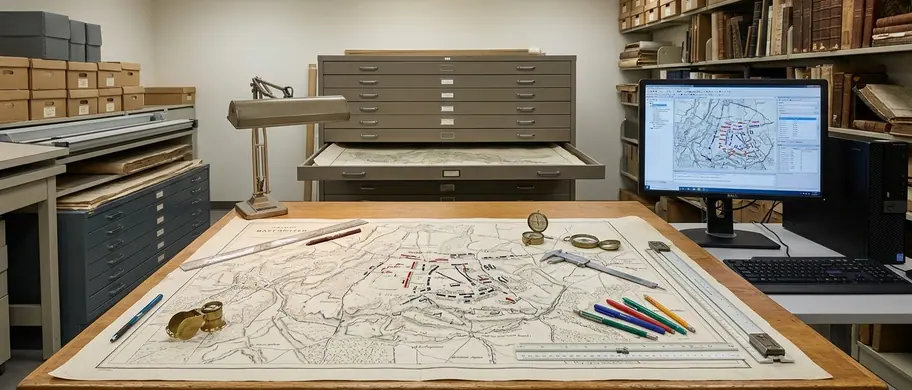
Mapping the exact regimental alignments during Johnston's wounding relies heavily on post-action reports written weeks later, as the immediate command decapitation left the May 31 evening positions largely unrecorded by staff officers. The breakdown of the courier system forced the commanding general to act as his own reconnaissance element. By riding forward to visually confirm Whiting's deployment, Johnston exposed himself to the random lethality of the front lines, transforming a staff failure into a strategic crisis.
The Eighteen-Hour Command Vacuum
Confederate military law at the time lacked a formalized second-in-command billet for field armies. Succession defaulted strictly to the date of rank among the major generals present on the field. Gustavus W. Smith assumed command of the army at roughly 8:00 PM, inheriting a disjointed force scattered across flooded terrain. Smith initially planned to renew the offensive at dawn, intending to press the advantage gained along the Williamsburg Road and drive the Federal forces back toward the Chickahominy River.
The immense pressure of army command rapidly degraded Smith's physical and mental state. By 6:00 AM on June 1, based on reported figures, Smith succumbed to a paralytic nervous condition. He issued no coherent orders to his wing commanders, leaving division leaders to manage isolated, uncoordinated firefights. The army sat idle as Federal reinforcements solidified their positions and brought fresh artillery batteries online.
Systemic Succession Vulnerabilities
Smith's tenure as army commander lasted approximately 18 hours, spanning from the evening of May 31 until early afternoon on June 1. This brief interregnum highlighted the systemic danger of an ambiguous chain of command. Relying on date of rank elevated an officer who possessed the seniority for the role but lacked the physiological resilience required for high command under combat stress. The resulting paralysis cost the Confederate army the initiative and allowed the Federal forces to stabilize a highly precarious operational front.
Presidential Intervention at the Front
President Jefferson Davis maintained a personal presence on the battlefield throughout the engagement. He observed the command paralysis firsthand, riding among the stalled columns and conferring with bewildered brigade commanders. Davis initially considered leaving Smith in command with Robert E. Lee acting as a rear-echelon advisor in Richmond. This proposed arrangement would have preserved the seniority system while injecting Lee's strategic acumen into the planning process from a distance.
Witnessing Smith's physical collapse at his field headquarters on the morning of June 1 forced an immediate change in strategy. Davis recognized Smith's absolute unsuitability for army command under combat conditions. The president abandoned the advisory compromise and took direct executive action to stabilize the military situation. Davis issued the formal order assigning Lee to command at 1:30 PM on June 1, 1862.
Lee officially assumed command of the newly christened Army of Northern Virginia at 2:00 PM. He immediately began issuing written directives to consolidate the defensive lines and extract the army from its vulnerable forward positions. This single battlefield casualty fundamentally altered the strategic trajectory of the Eastern Theater for the remainder of the war, replacing a cautious, defensive-minded commander with an aggressive tactician who would define the Confederate war effort.
Academic Sources
The War Department Collection of Confederate Records preserves archival correspondence used to establish the timeline of dispatch cessation and the subsequent issuance of executive orders on the field.
Tracing the Command Shift Through Archival Dispatches
Archival reconstruction of this command shift requires precise navigation of primary source documentation. Researchers tracing the transition must cross-reference the field dispatches in Series I, Volume XI, Part 1 of the Official Records with the personal memoirs of Davis and Smith. This triangulation resolves conflicting timestamps regarding Lee's arrival on the field and the exact moment executive authority transferred.
To reconstruct the exact sequence of the command transition at Seven Pines, begin by opening Series I, Volume XI, Part 1 of the Official Records. Turn to pages 433 through 435 to locate Johnston's final outgoing dispatches. Log the timestamp of his last message to W.H.C. Whiting, noting the abrupt cessation of his correspondence after 6:30 PM on May 31. Next, advance to the correspondence section for June 1 and isolate G.W. Smith's outgoing orders. Map the frequency and tone of Smith's panicked dispatches logged between 6:00 AM and 11:00 AM, specifically noting his repeated requests for reinforcements without providing tactical direction to his subordinates. Finally, locate Jefferson Davis's formal June 1 correspondence. Identify the specific dispatch time-stamped 1:30 PM assigning Lee to command, and cross-reference this with Lee's first general order issued at 2:00 PM to establish the exact 30-minute window where the Army of Northern Virginia changed hands.