
The Climax of Gettysburg Through the Eyes of the Combatants
By the early afternoon of July 3, 1863, the contest for the high ground south of Gettysburg had narrowed to a single, terrible gamble. After two days of inconclusive fighting on the flanks, General Robert E. Lee committed roughly twelve to fourteen thousand men of his Army of Northern Virginia to a frontal assault against the Union center on Cemetery Ridge. What we remember as Pickett's Charge began not with infantry but with an artillery cannonade that ran somewhere between 105 and 120 minutes, an estimated 150 to 170 Confederate guns concentrated on a single stretch of the Union line.
I want to take a different route through this familiar ground.
When I first scoped this material in the collection, the obvious starting point seemed to be the official after-action reports — clean, structured, written for the record. But those documents flatten the experience. They were composed by men who already knew how the story ended. The personal correspondence does something the reports cannot: it captures the psychological shock before the post-war narratives hardened into doctrine. So the focus shifted toward letters written within days of the event.
Three figures anchor this examination. Major General George E. Pickett, whose division gave the charge its name, wrote to his fiancée in the immediate aftermath. Lieutenant General James Longstreet — "Old Peter" to his men, left us a contested record built mostly in the 1880s and 1890s. And on the receiving end stood Major General Winfield Hancock, commanding the II Corps along the ridge. Reading these accounts side by side, immediate against retrospective, reveals how memory reshapes even the most vivid experience.
The Confederate Vanguard: Pickett's Immediate Reactions
Pickett's letters to LaSalle Corbell, written on July 3, July 4, and July 6, trace an emotional collapse in near real time. The July 3 letter still carries the charged anticipation of a man about to lead his division into history. By July 4, the tone has fractured. By July 6, it reads like grief.
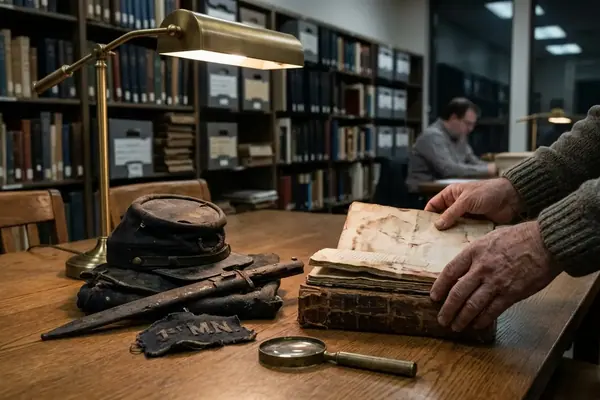
During transcription, I cross-referenced the handwriting in the July 4 and July 6 letters against Pickett's pre-battle correspondence. The degradation is striking — the controlled hand of early summer gives way to something hurried and uneven, consistent with physical exhaustion and emotional strain. The paper itself testifies to what the words describe.
And what the words describe is annihilation.
Pickett's division lost all three of its brigade commanders in the assault: Armistead, Garnett, and Kemper. The loss of leadership ran deeper still, with all thirteen of his regimental commanders killed or severely wounded. He returns again and again to "Old Lewis" — Brigadier General Lewis Armistead, who fell at the Union guns after crossing the wall. The intimacy of that mourning is what makes the correspondence so valuable, and so fragile as evidence.
A Caution on Provenance
Here the archivist must speak plainly. The authenticity of these published letters is heavily contested. LaSalle Corbell Pickett is known to have edited, and likely fabricated, substantial portions of the correspondence before publishing it in 1913.
Relying on the 1913 published versions without consulting the surviving original manuscripts leads to a highly romanticized and historically inaccurate view of the Confederate command's immediate reaction.
Caution: Treat any quotation drawn from the 1913 edition as suspect until it can be matched against a surviving manuscript. The emotional truth may survive even where the literal text does not — but a researcher should never conflate the two.
The Union Defense: Hancock's Line on Cemetery Ridge
From the opposite ridge, the same assault looked entirely different. Hancock's II Corps held a front of roughly 1,000 yards, and into that center the Confederate force of twelve to fourteen thousand men advanced across open ground in full view.
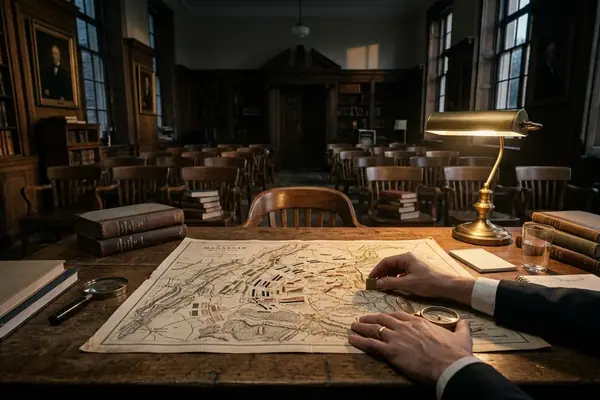
I had originally hoped to map Hancock's movements minute by minute along the line. That ambition collapsed quickly. The timestamps in subordinate reports overlap and contradict one another so badly that any precise chronology would be a fiction dressed as scholarship. The honest reconstruction is impressionistic, not clockwork.

What the Union accounts convey best is the visual weight of the advance — long gray lines emerging from the treeline, dressing their ranks under fire, closing toward the wall. The defense required improvised coordination as much as standing courage: artillery shifting to canister, regiments wheeling to plug gaps, officers riding the line to steady men under the strain. Hancock himself remained mounted and exposed, a deliberate act of command presence, until he was wounded late in the fighting.
One archival note worth flagging: the tone of Union after-action reports varies sharply depending on when they were drafted. Reports written in the raw hours after July 3 read differently from those composed weeks later, once the War Department grasped the strategic magnitude of the victory. The later documents carry a confidence the moment itself did not possess.
Retrospective Analysis: Longstreet's Post-War Defense
Longstreet's record presents the opposite problem from Pickett's. Where Pickett wrote in the heat of the event, Longstreet wrote across decades of accumulating defensiveness. His memoir, From Manassas to Appomattox, appeared in 1896 — a full thirty-three years after the battle. It rests not on a wartime diary, which he had lost, but on post-war correspondence gathered between 1888 and 1895.
That gap matters. A memoir built from solicited letters is a different artifact than a contemporaneous account; it is argument as much as recollection.
To understand his combative posture, consider the moment of his 1885 New York Times interview, published July 24. In the preceding six months, Southern editorialists had escalated their attacks on him, casting him as the man who lost Gettysburg through delay and disobedience. Read against that pressure, the interview is less a neutral analysis of the charge's tactical failures than a calculated defense. Longstreet had advised against the assault; in his retrospective accounts he works steadily to clarify — and at times to relocate, responsibility for the July 3 defeat.
Main Point: Longstreet's later writings are best read as evidence of an ongoing argument, not as detached testimony. Their value lies precisely in what they reveal about how the blame was contested.
Memory and Reconciliation: The Veterans' Later Years
The decades after Appomattox produced a stranger record than the war itself — one of former enemies finding their way back to one another. The relationship between Longstreet and Ulysses S. Grant is the clearest example, and one I traced strictly through their direct correspondence rather than the romanticized secondary literature that later grew around it. The image of the two men at a game of "Brag" survives as a small, human counterpoint to the carnage they had shared.
Reconciliation was never simple, and Longstreet embodied its contradictions. Reviled in much of the South, he became a willing symbol of national reunion in the North.
His appearance at a 1902 Memorial Day parade — marching alongside Union veterans in a Northern city, stands as one of his final public reconciliatory gestures. He died just two years later, in 1904. Watching an aging Confederate general honored by his former adversaries, one sees how thoroughly the meaning of Pickett's Charge had shifted in forty years. The assault that had been a catastrophe for the Army of Northern Virginia was becoming, in the public imagination, a shared monument to courage on both sides.
Scope and Limitations of the Primary Record
Every source examined here carries its own distortion, and an honest finding aid names them.
The immediate battlefield letters suffer from the fog of war. The July 1863 correspondence was written by exhausted men who could not yet see the whole field, whose knowledge was bounded by smoke, noise, and the few hundred yards in front of them. Their immediacy is their strength and their limit at once.
The post-war memoirs suffer from ideology. The Lost Cause narrative did not arise spontaneously; it was constructed. The Southern Historical Society Papers began systematic publication in 1876, and over the following two decades they actively shaped the story that blamed Longstreet for the July 3 defeat. Tracking the publication dates of Jubal Early's pieces against Longstreet's rebuttals lets us reconstruct a timeline of an argument unfolding, each side responding to the other.
I'll add one qualification specific to this body of evidence. Because the most emotionally compelling Confederate letters survive primarily through a heavily edited 1913 publication, the very documents that feel most authentic are the ones most in need of verification against surviving manuscripts. That tension — vividness pulling one way, provenance pulling the other, defines the entire archive of Pickett's Charge.
For researchers seeking primary documentation, the National Archives Civil War records remain the appropriate starting point for official reports and service records that can anchor the personal accounts.