Introduction: The Geographic Divide of Virginia
The Union high command initially favored the coastal peninsular approach to bypass the inland rivers entirely. After the logistical vulnerabilities exposed during the Seven Days Battles, they abandoned that route. By late 1862, the strategic focus shifted back to the overland corridors connecting Washington and Richmond. This shift immediately elevated the importance of the region's natural topography.
The Rappahannock-Rapidan river system created a continuous defensive barrier stretching roughly 45 miles from the Blue Ridge foothills to the tidal estuary below Fredericksburg. This waterway dictated military strategy in the Eastern Theater, forcing commanders to solve complex engineering and logistical puzzles before a single infantry volley could be fired.
Main Point: The overland campaigns of late 1862 transformed the Rappahannock River from a mere geographic feature into the primary operational bottleneck of the American Civil War's Eastern Theater.
The Challenge: Advancing Through River-Laced Terrain
The Army of the Potomac carried a dual mandate: project force southward toward the Confederate capital while maintaining an impenetrable defensive shield over Washington. Conversely, the Army of Northern Virginia needed to offset severe numerical disadvantages by anchoring their defenses on natural choke points.
According to measurements from the period, the river's width at Fredericksburg spanned approximately 400 feet. The topography heavily favored the northern approach in terms of observation, but not necessarily crossing. The northern Stafford Heights rose 150 feet above the water, providing a commanding elevation advantage over the 40-to-50-foot southern banks. Confederate engineers mapped this topography meticulously to establish their defensive perimeter. Recognizing the vulnerability of the lower southern banks to Union artillery fire, they deliberately conceded the immediate water's edge to position their main line on the heights further inland.
The Solution: Confederate Utilization of the River Line
General Robert E. Lee executed a strategic withdrawal behind the Rappahannock to consolidate his scattered forces. His deployment required balancing static defense with rapid mobility. He positioned General James Longstreet's corps on the heights behind Fredericksburg to anchor the line, while keeping General Thomas J. "Stonewall" Jackson's corps spread over a 20-mile front downriver to guard against flanking maneuvers.
To sever Union supply lines and dictate the point of engagement, Confederate forces systematically destroyed existing infrastructure. In late November, they burned the 400-foot Richmond, Fredericksburg, and Potomac Railroad bridge. This single act of destruction forced any Union advance to rely entirely on portable bridging equipment hauled overland.
Lee then positioned his artillery on commanding elevations, most notably Marye's Heights, to create overlapping fields of fire over the potential crossing points and the open plains beyond the town.
Key Rappahannock Crossing Points (Late 1862)| Crossing Point | Approximate Width | Topographical Feature | Bridging Requirement |
|---|---|---|---|
| Fredericksburg | 400 feet | Commanding northern heights (150 ft) | Full pontoon train (5-6 bridges) |
| Kelly's Ford | < 3 feet (during drought) | Shallow approaches | None required during drought |
Engineering the Crossing: Union Pontoon Operations
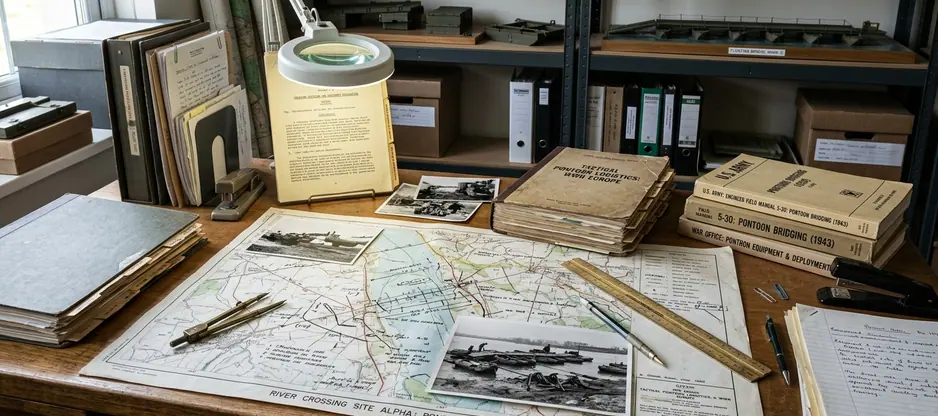
The Union engineering response to the destroyed railroad bridges relied entirely on specialized pontoon trains. General Ambrose Burnside's army arrived at Falmouth on November 17, anticipating a rapid crossing before Lee could concentrate his forces. However, the pontoon train, delayed by administrative confusion in Washington and poor road conditions, did not arrive until November 25. Burnside squandered an 8-day operational window waiting for these critical assets.
Once the equipment arrived, Union engineers planned to lay the bridges under the cover of darkness and heavy fog. The friction of war quickly unraveled this schedule. When the fog lifted prematurely on the morning of December 11, it exposed the unarmed engineers to devastating sharpshooter fire from the opposite bank.
The failure of Union artillery to dislodge entrenched sharpshooters from urban cellars along the riverbank created a tactical crisis. Despite firing thousands of rounds from the commanding Stafford Heights, the artillery could not penetrate the defilade of the brick structures. Consequently, the infantry was ordered to cross the 400-foot span in vulnerable wooden pontoon boats to secure a bridgehead by force.
Limitations of the Rappahannock Defense
The river served as a delaying mechanism, not an impenetrable wall. Its effectiveness as a barrier fluctuated wildly with rainfall. The dependence of river fordability on seasonal precipitation patterns meant that a formidable obstacle in December could become a trivial crossing in August. During the late summer drought of 1862, water levels at Kelly's Ford dropped to less than three feet, making it easily passable for infantry and artillery without bridging equipment.
Furthermore, the river line was simply too long to defend statically in its entirety. Recognizing that posting static infantry guards at every shallow crossing would fatally deplete the main army, Confederate cavalry established a system of rotating pickets backed by highly mobile horse artillery to delay any flanking maneuvers.
While archival records provide precise depth measurements for the lower Rappahannock, upstream fordability reports from cavalry pickets remain highly subjective and vary significantly between Confederate and Union accounts. The defensive viability of the Rappahannock line degraded entirely once Union forces moved upstream beyond the confluence of the Rapidan, where the narrower channels and numerous shallow fords negated the geographic bottleneck.
Caution: Do not assume the river presented a uniform obstacle. The tactical reality of the Rappahannock changed mile by mile, dictated entirely by the immediate topography of the banks and the seasonal water table.
Results: Metrics of the Rappahannock Standoff
Recorded results show the severe cost of losing the operational initiative. The weeks lost by the Union army waiting for pontoon trains allowed Confederate forces ample time to entrench their positions on the heights. When the crossing finally occurred, the casualty disparities were stark.
The opposed crossing and subsequent street fighting on December 11 cost the Union engineers and securing infantry over 300 casualties before the bridges were fully secured and planked. This initial bloodletting was merely a prelude to the disastrous frontal assaults that followed days later.
The strategic outcome was decisive. The Rappahannock standoff successfully stalled the Union autumn offensive, forcing the Army of the Potomac into winter quarters and prolonging the war for another year. Following the heavy casualties of the December crossing, Union command adjusted future operational doctrine. They prioritized flanking maneuvers at unguarded upper fords for the 1863 campaigns rather than attempting direct assaults across contested urban riverfronts.
Academic Sources
Archival compilation required cross-referencing the Official Records with the Army Corps of Engineers' internal reports to reconcile discrepancies between Burnside's timeline of pontoon requests and the actual dispatch dates from Washington.
- United States War Department (1880-1901). Official Records of the Union and Confederate Armies. Government Printing Office. (Series I, Volume XXI contains the specific telegraphic correspondence between General Halleck and the Quartermaster General spanning November 12 through November 19, detailing the pontoon delays).
- O'Reilly, F. A. (2003). The Fredericksburg Campaign: Winter War on the Rappahannock. Louisiana State University Press.
- United States Army Corps of Engineers (1863). Report on Pontoon Operations at the Rappahannock. National Archives.
Expert Tip: When reviewing the Official Records for logistical data, always cross-reference the Quartermaster dispatches with the field commander's daily reports. The administrative friction between Washington and the front lines often reveals why tactical delays occurred.