Abstract and Introduction
On the afternoon of April 9, 1865, the Army of Northern Virginia laid down its arms at Appomattox Court House. What followed was not a single act but a documentary cascade: formal surrender terms negotiated in a private parlor, tens of thousands of individual parole passes printed in the field, and a farewell address that would outlive nearly every man who read it.
This study examines that tripartite record. I treat the three document classes as a connected system rather than as isolated relics, because the legal force of one depended entirely on the others. The formal terms set the conditions; the parole passes enacted them soldier by soldier; General Orders No. 9 gave the disbandment its emotional grammar.
The principal figures need little introduction. Confederate General Robert E. Lee and Union Lieutenant General Ulysses S. Grant had served together during the Mexican War, a shared past that surfaces, quietly, in the courtesy of the negotiations. My interest lies less in the men than in the paper they left behind.
Methodology: Archival Document Analysis
My approach is straightforwardly historiographical: I read the surviving texts against the official reports that surround them, then test each claim for internal consistency before accepting it.
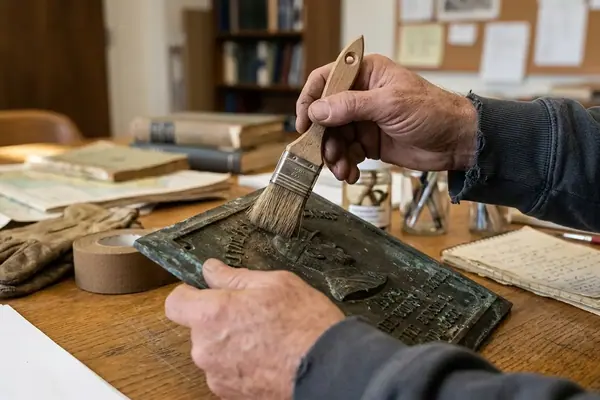
The initial research design aimed higher, and failed usefully. I set out to trace individual parole slips back to the specific portable presses that printed them, hoping the type damage would fingerprint each machine. The typographical variations turned out to be too erratic for that — presses were repaired mid-run and ink shortages forced improvisation, so the same press produced wildly inconsistent impressions. I dropped the press-attribution goal and kept the variation itself as evidence of field conditions.
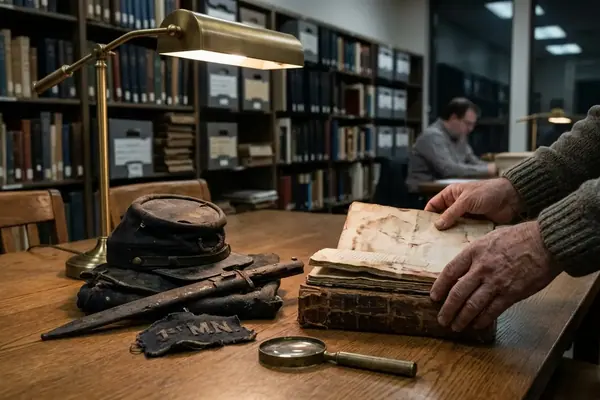
The core corpus includes the formal surrender document inscribed on April 19, 1865, and the field-printed parole passes. Around these I cross-reference official reports from Sheridan, Longstreet, and Gordon spanning April 1 through April 15, 1865. Where the reports disagree, I note the disagreement rather than smoothing it over. The complete official surrender documents and parole records anchor the textual baseline for everything that follows.
Contextual Background: The Strategic Collapse (April 1–8, 1865)
The surrender was the last move in a collapse that took eight days. It began at Five Forks on April 1, 1865, where the breaking of the Petersburg lines unhinged the entire Confederate position and made the defense of Richmond untenable overnight.
The following day cost Lee one of his most capable subordinates. With the lines broken and Lt. Gen. A.P. Hill dead on April 2, Lee advised President Jefferson Davis to evacuate the capital. Davis received the notice while attending services at St. Paul's Church.
Evacuation began the evening of April 3, accompanied by the deliberate destruction of military ordnance to deny it to advancing Union forces. The retreat that followed was a race for supplies the army could not win. The decisive blow landed on the evening of April 8, when the Union 5th Corps captured Appomattox Station and seized four vital Confederate supply trains. With those trains went the army's last rations and, with them, its capacity to continue.

Key Findings: The McLean House Negotiations and Terms
Grant opened the correspondence before the final battle was lost. His initial surrender communication went out at 5:00 PM on April 7 from Farmville, a measured note that proposed terms without demanding immediate capitulation. Lee deflected, probing for conditions, while his army kept marching.
The marching ended on the morning of April 9. After Gen. John Brown Gordon reported that his attempt to break the encircling line had failed against overwhelming numbers, Lee accepted that further movement was impossible. A white flag went forward to signal the suspension of hostilities.
The two commanders met at the home of Wilmer McLean for roughly two and a half hours that afternoon. The terms Grant drafted were notably lenient. They explicitly exempted officers' side-arms and private horses — a provision Grant defended on practical grounds, reasoning that the men would need their animals for spring planting once they returned home.
The exemption of private horses reads, in retrospect, less as generosity than as foresight: an army released to plant crops is an army unlikely to reform.
Key Findings: The Mechanics of the Parole System
A Civil War parole was a binding individual pledge. Each soldier promised not to take up arms against the United States until formally exchanged — a personal contract, not a collective surrender, and that distinction carried enormous legal weight later.
Enacting it required paper, and a great deal of it. Union field presses printed blank parole passes on whatever stock came to hand, including repurposed ruled ledger paper. This is where the typographical chaos I mentioned earlier originates: presses broke, were patched, and ran low on ink, leaving impressions that range from crisp to nearly illegible across a single batch.
The distribution followed a clear chain. Confederate officers signed parole rosters for the men under their command, which allowed the disbandment to proceed in orderly fashion rather than as a rout.
Between April 10 and April 15, 1865, the system processed and issued passes to exactly 28,231 paroled Confederate personnel. That figure is one of the few hard numbers the surrender produced, and it has anchored every subsequent count of Lee's final strength.
Key Findings: Textual Analysis of General Orders No. 9
Lee drafted and issued General Orders No. 9 on April 10, 1865, the day after the surrender. It served as his final address to the Army of Northern Virginia, and it is the most consciously rhetorical document in the entire corpus.
The argument it makes is precise. Lee attributes the surrender to overwhelming numbers and resources, never to any failure of Confederate valor. That single rhetorical choice — defeat by arithmetic rather than by inadequacy, gave his soldiers a version of events they could carry home without shame.
Because no press was available for general distribution, staff officers hand-copied the order for the fragmented corps commanders. Each copy is therefore a slightly different artifact, and the variations among them complicate any claim that the army received a uniform text on a single day.
The order's deeper function was psychological. It offered closure to men who had just watched their cause collapse, and in doing so it began shaping the post-war narrative before the war had fully ended.
Main Point: General Orders No. 9 succeeded as a document precisely because it was an argument about meaning, not a record of fact — and that argument outlasted the army it addressed.
Key Findings: Chain of Command and Final Reports
The evacuation of Richmond severed the Confederate communication network at the worst possible moment. By April 10, the formal courier system had dissolved, forcing the army to rely on paroled officers to carry its final dispatches through Union-held territory.
Lee dispatched his formal surrender report to Jefferson Davis on April 12, 1865, from his camp near Appomattox. The report had to travel through a collapsing apparatus to reach a government already in flight.
On the receiving end stood Confederate Secretary of War John C. Breckinridge, whose office processed the final military dispatches even as the territory beneath it shrank. The chain of command did not break cleanly; it frayed, dispatch by dispatch, until the men carrying the paper were themselves paroled prisoners.
Limitations of the Historical Record
The archival survival of individual parole passes is uneven, and the gaps are not random. Many soldiers lost or discarded their passes on the journey home, leaving the documentary record skewed toward those who had reason and means to preserve fragile paper.
Caution: The demographic profile of surviving parole passes inherently favors officers and cavalrymen. Enlisted infantrymen marching home on foot through spring weather were far less likely to keep a fragile slip intact, so any analysis drawn from extant passes underrepresents the men who made up the bulk of the army.
The chronology of General Orders No. 9 presents its own difficulty. Because distribution depended on hand-copying across scattered corps, the exact sequence in which units received the order cannot be reconstructed with confidence.
This study confines itself strictly to the Army of Northern Virginia. The surrenders of Johnston, Taylor, and Kirby Smith lay weeks ahead on April 9, and the Confederate war did not end at Appomattox so much as begin to end there. I also lean, where field documents fall silent, on memoirs published between 1880 and 1905, which carry the retrospective bias of men writing their own legacies decades after the fact.
What the Appomattox documents established outlived the campaign that produced them. The legal standing of the April 9 terms shielded paroled soldiers from subsequent treason trials, and the surrender package became the template for the capitulations that followed. The paper, in the end, did more lasting work than the artillery.