Forging an Independent Strike Force
The Army of the Potomac entered the Peninsula Campaign with a highly decentralized approach to artillery deployment. Brigade commanders maintained direct control over their attached batteries, treating cannons as localized infantry support rather than a unified operational asset. Henry Hunt initially attempted to coordinate massed fires within this existing framework by sending couriers to individual brigade commanders to requisition their guns. The communication delays at Gaines' Mill proved fatal to rapid concentration. Couriers navigating chaotic rear areas, choked with retreating infantry and supply wagons, rarely delivered orders in time to mass guns against sudden Confederate breakthroughs. The resulting piecemeal deployment allowed Confederate forces to overwhelm isolated Union batteries one by one.
Hunt abandoned this decentralized protocol entirely following the disaster at Gaines' Mill. He consolidated approximately 100 guns into a mobile strike force distinct from the infantry corps structure. This massive reorganization required the establishment of a dedicated command staff and an independent logistical train prior to the Seven Days Battles. Pulling batteries away from protective brigade commanders demanded immense administrative leverage, but it gave Hunt the authority to deploy artillery at the army level. The Artillery Reserve emerged as a unified tactical entity under his direct command, capable of moving rapidly across the battlefield to anchor vulnerable sectors or exploit offensive opportunities.
The creation of this reserve fundamentally altered the operational tempo of the Union army. Commanders could now rely on a dedicated artillery reserve to shape the battlefield independent of infantry maneuvers. Hunt's staff officers mapped terrain, calculated ranges, and directed battery placements with a level of technical precision previously absent from the Army of the Potomac. A collection of disparate batteries had become a cohesive instrument of destruction.
Topography and the Crescent Formation
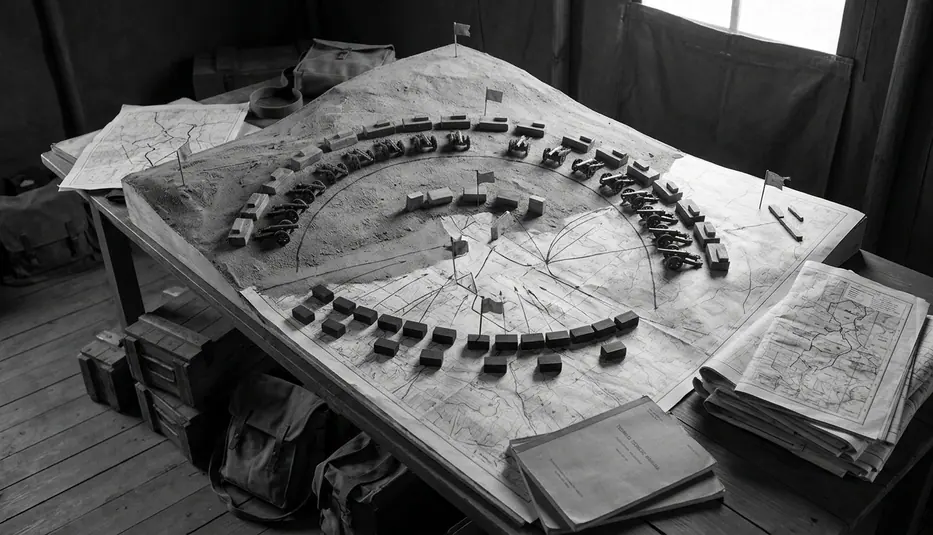
Malvern Hill offered a formidable natural redoubt for this newly centralized force. Hunt surveyed the plateau and deliberately positioned his heavier siege guns on the highest crests. He placed lighter 12-pounder Napoleons on the lower slopes to create overlapping, unobstructed fields of fire. The batteries spanned a crescent formation roughly 1.5 miles wide, anchoring the Union line against the James River to the south and dominating the open ground to the north. The 150-foot natural elevation of the plateau allowed Hunt to bring some 60 guns to bear directly on the northern approaches simultaneously.
The geometry of this deployment maximized the lethality of every artillery piece. Heavier guns on the crest fired over the heads of the Napoleons positioned below them, creating a tiered wall of iron that covered every conceivable avenue of approach. Confederate infantry advancing across the open ground faced converging crossfire from multiple angles. The crescent shape of the Union line ensured that any attacking column would be enfiladed by batteries on the flanks while taking direct fire from the center.
The lethality of this tiered crescent formation relied entirely on the absence of dense foliage on the plateau's northern slope. Had the terrain been heavily wooded like the previous days' battlefields at Glendale, coordinating overlapping fields of fire across multiple battery elevations would have been impossible. The cleared ground turned the slope into a precisely measured kill zone, allowing Union gunners to track Confederate formations from the moment they emerged from the distant treeline.
Ammunition Loop Mechanics
Sustaining a high volume of fire across a 1.5-mile front required an exacting logistical framework. Some individual guns fired upwards of 200 rounds during the afternoon and evening engagements. The sheer physical toll on the artillery crews was immense, as gunners swabbed, loaded, and fired their pieces continuously for hours in the July heat. To prevent guns from falling silent during sustained assaults, Hunt established a continuous loop system for the caissons.
As soon as a limber chest was depleted, a fully stocked caisson from the reserve train at Malvern House was already moving up to replace it. This system bypassed the standard requisition chain entirely. Hunt kept the reserve ordnance train forward, just behind the crest, to minimize turnaround times. Drivers navigated their heavy wagons through incoming Confederate counter-battery fire, swapping empty caissons for full ones with practiced efficiency. The Union batteries never slackened their rate of fire, even at the height of the Confederate assaults.
Range Discipline and the 400-Yard Threshold
The tactical execution of the barrage demonstrated strict fire discipline across the entire Artillery Reserve. The sustained barrage began in earnest around 1:00 PM as Confederate forces began probing the Union lines. Hunt directed battery commanders to hold canister fire until the Confederate lines closed to within 400 yards. Gunners relied strictly on spherical case and shell for the longer ranges to disrupt formations before they could organize a cohesive charge. Spherical case shot, designed to burst in the air and scatter iron balls over a wide area, proved devastating against massed infantry attempting to deploy in the open fields.
The discipline required to hold canister fire until the 400-yard mark maximized the shock value of the close-range defense. Canister essentially turned the cannons into massive shotguns, unleashing a lethal cone of lead and iron that could tear massive gaps in an advancing line. By waiting until the Confederate columns reached this critical threshold, Union gunners ensured maximum casualties with every discharge. The overlapping fields of fire meant that a single Confederate regiment might face canister from three different batteries simultaneously.
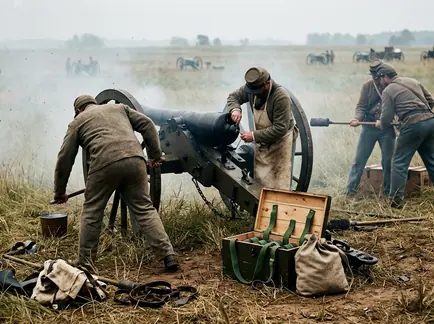
The artillery fire reached its peak intensity between 5:30 PM and 7:30 PM, against the assaults of D.H. Hill and Magruder. Confederate commanders struggled to coordinate their attacks, sending brigades forward in isolated waves that were systematically dismantled by the Union guns. The sustained rate of fire prevented Confederate forces from organizing effective counter-battery fire. Union gunners quickly silenced the few Confederate batteries that managed to unlimber on the edges of the battlefield, maintaining absolute artillery supremacy throughout the engagement.
The Permanent Shift in Union Doctrine
Following the battle, Union high command permanently adopted Hunt's model of centralized artillery control. The organizational model established in July 1862 remained the foundational artillery doctrine for the Army of the Potomac through the Gettysburg campaign. It solidified the authority of the Chief of Artillery over corps-level battery deployments, ensuring that the army would never again suffer the fragmented artillery response that had plagued it at Gaines' Mill. Cannons ceased to be mere infantry support and became an independent mechanism for battlefield dominance.
The success at Malvern Hill validated the concept of the Artillery Reserve as a decisive operational tool. Hunt's ability to mass fires, sustain logistical support, and enforce strict range discipline set a new standard for artillery operations in the Eastern Theater. The centralized command structure allowed the Union army to exploit its industrial advantage in ordnance and equipment, translating material superiority into tactical victory on the battlefield.
Academic Sources
Historical consensus on Hunt's tactical decisions was synthesized by cross-referencing his post-war accounts in 'Battles and Leaders' with the contemporaneous after-action reports filed in the Official Records. Hunt's personal documentation of ammunition expenditures and battery placements provides a granular view of the logistical effort required to sustain the defense. Researchers can consult the Official Records of the Union and Confederate Armies, Series I, Volume XI, Part 2, for the primary source reports detailing the regimental-level impact of the artillery barrage.
Did the infantry merely spectate a battle already won by the gunners, or was Malvern Hill a combined-arms victory where the artillery simply masked the infantry's vulnerabilities?